The best stop order: round trip, fixed destination or open end
Last reviewed: October 31, 2026
With 10 stops there are more than 360,000 possible orders; with 15 there are more than 87 billion. A route planner does not try them all – it calculates cleverly. What matters is giving it the right settings.
Try it now: free up to 25 stops, no sign-up →
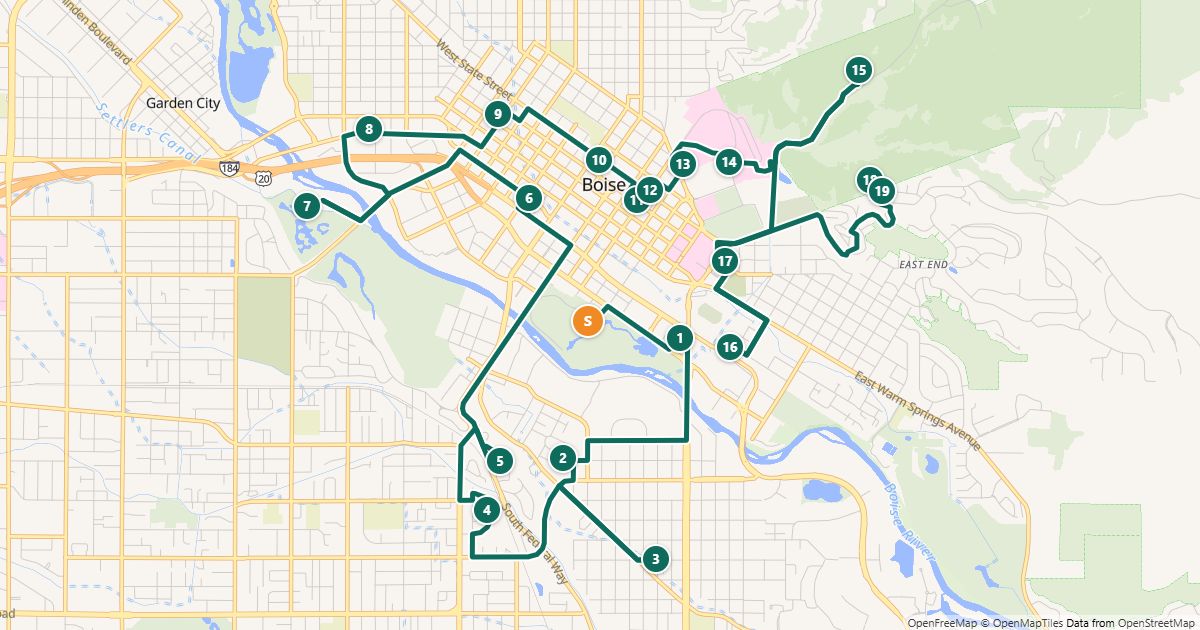
Set the start and the end
The start is always the first stop in your list. The planner sorts all other stops.
- Round trip: you come back to the start – typical when your shop, depot or home is the starting point.
- Fixed last stop: the route ends at a specific place, such as your last appointment or a drop-off point.
- Open end: the planner picks the end that makes the route shortest – good when you are free afterwards.
Driving time or distance?
Optimizing for driving time favors fast roads, even if they are a little longer. Optimizing for distance saves miles but accepts slower roads.
For most routes, driving time is the better choice. Distance pays off when miles cost money, for example with mileage reimbursement.
How RouteTidy calculates
- First, RouteTidy gets driving times and distances between all stops on the real road network (OpenStreetMap, without live traffic).
- For up to 12 movable stops it calculates the provably best order.
- For larger routes it improves a good starting solution step by step (2-opt and Or-opt). The result is very good but not guaranteed optimal – the planner tells you which case applies.
What it does not do (yet)
Enter fixed appointments as a time window per stop (earliest/latest, plus the departure time). Being on time then comes before the shortest route; the order is a very good approximation, not guaranteed to be the best.
Free for routes with up to 25 stops, nothing to install.
Plan a route nowQuestions
- Why is the order different from mine?
- The planner knows the driving times between all stops and often finds orders that look unusual on the map but are shorter. The result shows before and after.
- How much does an optimized order save?
- It depends on how well the list was sorted before. In our example routes built from unsorted lists, the distance dropped substantially – the numbers are on the use case pages.
More guides
- How to use Google Maps with more than 10 stops
- Import an address list from Excel or CSV
- Share a route with your drivers
- How much time does an optimized route save?
- Calculate the mileage cost of a route
- Clean up addresses for route planning
- Paste addresses from an email or document
- Drive your route with Apple Maps or Waze
- Split stops across several drivers or days
- Customer addresses and privacy
- Plan your daily route faster
- Google Maps vs. a route planner: when to use which
- Free route planner for many stops: the checklist
- Route planner without an app
- Plan a route with multiple stops
- Plan routes by bike or on foot
- Breaks in route planning